
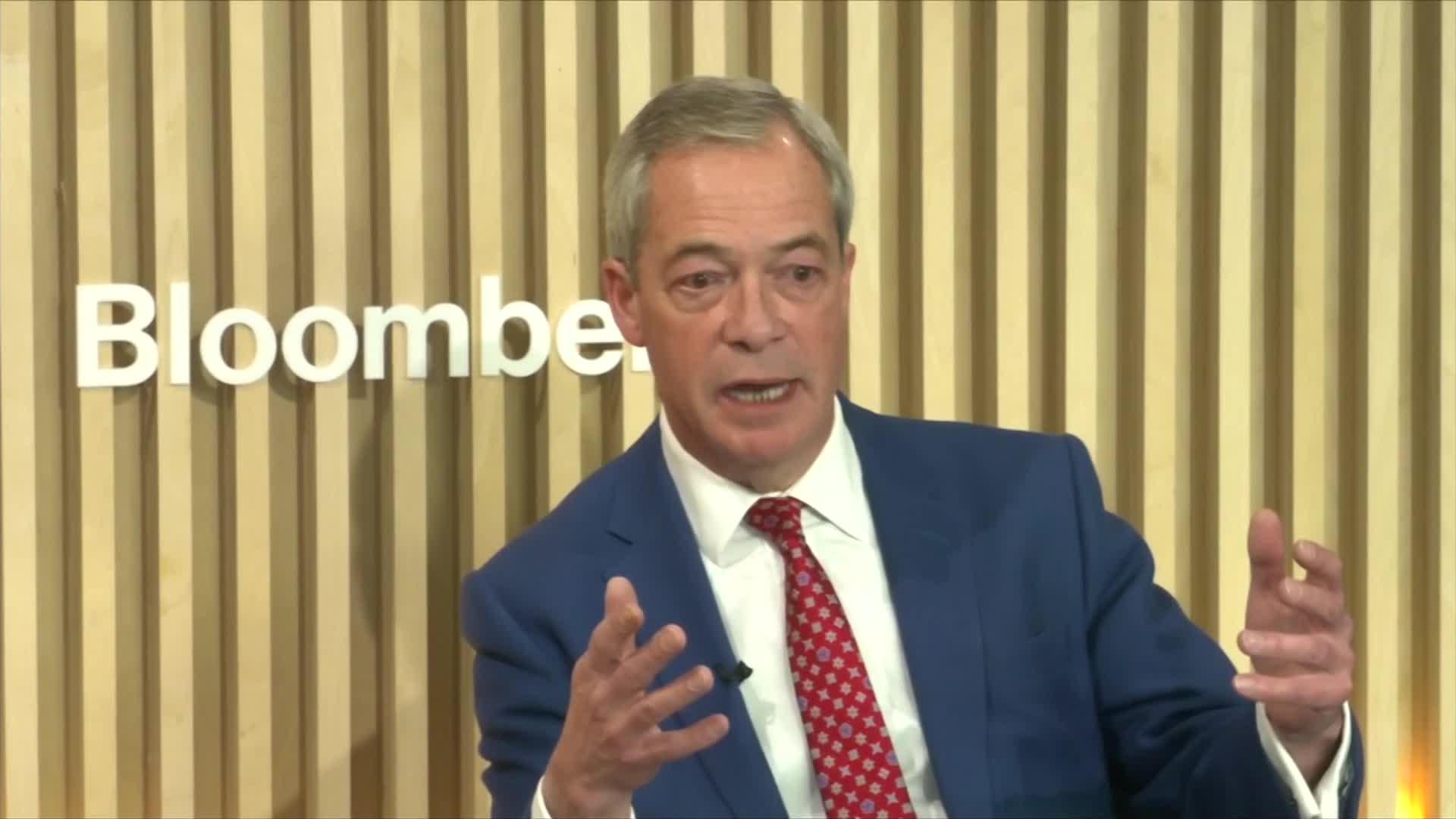
Surprised to see you used to really slag off all the globalists at the West. I slagged off the European Parliament for 20 years, but I still went there once a month and I think I genuinely upset them virtually every time I turned up. Isn't it interesting? I mean, you know, five years ago here at Davos, the main topic of conversation was climate change. Did I or that baloney. And here we are five years on and the debate is completely different. It's being dominated by a high tech energy. And the one thing I've enjoyed over the last couple of days, there is genuine debate. There are different opinions now rather than the sort of consensus view that I certainly felt was coming out from the globalists. So yeah, no, I find it really interesting and worthwhile. Well, one consensus, I mean, you and I talked about this is sort of it is quite funny that there's so many honest conversations this week and it sort of suggests, you know, what were the conversations like before? But we have. Well, I think it's interesting. I mean, ten years ago, we had the Brexit referendum result. We had Trump winning the presidency. And I think everyone thought, well, these are just aberrations. These are short term. Right. But Tony Blair saying these are sort of short term fits of rage. Normal service will be resumed. And now everyone realizes that actually these were the first tremors of a very, very major change in political conversation and debate. And that, I think, now is writ large. Well, I want to get into I think a lot of people are interested in how you're seeing kind of foreign policy, the UK's role in in this new world that we've all been talking about this week. But just to get into sort of core Bloomberg territory for a few minutes, one of the consensus views out there, if you ask economists, many people in the city, what would happen to UK borrowing rates if a reform government took power, they'd go up. At least that's the consensus. So why do you think investors would be seem to be quite nervous about reform? Yeah, well, as a former as a former commodities trader, if there's a big consensual view, take the opposite trade position. I've always believed in that quite strongly. And look, I think one lesson I mean, look, obviously we're talking about supply side reform. One of the big frustrations is that since Brexit, businesses, particularly small and medium size businesses, are now more heavily regulated, more penalised by HMRC, whichever regulator is relevant to their area than they were before Brexit. It's a massive frustration. So do we want to reduce the size, the administrative state? Yes. Do we want to attempt genuine supply side reform? Absolutely. Do we want to cut taxes? Do we want rich taxpayers to flee the country and young entrepreneurs to flee the country every year or come back to the country, invest, employ people, spend money. So that's the agenda. And people say, well, if you do all of that, you're kind of going to be following a little bit of the Kwasi Kwarteng budget and the markets are going to take fright. So that's where the view comes from. And I think the one big lesson. From the trust choir saying budget is they did not propose to cut spending. They basically said we won't increase spending in line with inflation. So for our program to work, what we absolutely have to do is to say to people, we are going to reduce welfare spending, we are going to reduce excessive government waste. And I think if we do that, the markets will applaud it. One of the big ways in your program that you are you step back from some of the more sort of aggressive tax cut promises. So it's an aspiration. But one of the big savings in your plan currently is to get more money to say to save money that the Bank of England currently spends on paying interest on bank reserves. So as you know, there's a lot of concern about that from the Bank of England. They think they're going to lose control over interest rates, which is pretty cool part of their monetary policy. And certainly bankers quite clearly see whether it's I mean, I think you said 30 billion. 35 billion. Yeah. Then I think it's more like 20 billion. But that's a 20 billion tax on banks. Yeah. That's less relevant now than it was because we're not going through the QE programme in quite the same way we were before, as you know. But the opposite has been happening in some regards. So that's where some of the savings come from is from the kitty. We were the only party to point out just how much this was costing, and I think that's what we're good at. What we're good at is introducing new debates. And it was very interesting when I went to meet Richard HAASS and I went to meet the governor of the Bank of England, which was a very interesting clash of cultures, I would say. And I just said, it's really interesting that you're making massive decisions here that have a huge impact on public finances, and yet it's been done with no debate in parliament whatsoever. But that's not true. I mean, they have it's not it's true that there's no Reform MPs on the select committee, but they go all the time to give testimony to the House of Parliament. Yeah, the government controls and these subjects hate these policies, actually these agreements with the treasury of what they've been doing. And these subjects don't get talked about properly and there's no proper open debate. And frankly, the committee system in the UK doesn't get the coverage, doesn't get the publicity. We have not had any debate in the floor of the House of Commons on this subject at all. But you say you're going to do it. It's a part of your plan. It's not just part of your plan to discuss it. Now we're going to do it at least 20 pages. We're going to do it and tax the banks. And some of the banks won't like it. You're quite right. They will all possibly. I don't like consumers. What? I don't like the banks very much because they did bank me, didn't they? I wouldn't give they wouldn't give me an account and try to force me out of the country. No, look, this would be tough for banks to accept. I get that. But how do you take the drain on people? I'm sorry, but the drain on public finances is just too great. But how do they make their money if they don't make it there? Don't you think it's pretty clear it's going to go onto interest margin, It's going to go onto more mortgage costs and the interest rates they charge your utilities or they become more or they become more efficient or they cut costs or they do whatever this money. They should not have had this money. Look, frankly, the whole QE programme has not achieved anything very much other than to make the rich richer and the poor poorer. And everything we've done on QE since George Osborne and co put it into place has been bad for most people in the country. That's I mean, that's been really helpful because it's very clear you you're very happy to have a very hefty extra tax on banks. It's not it's not more anti bank, it's not a tax that is not going to get free money anymore. It's taking £20 billion from the banks. It doesn't really matter how they'll adapt that to just business does. Right. You disagree with the Bank of England governor on that. If we have an election on schedule, there will be a new Bank of England governor. By the time you would become prime minister, they'd come in an early 28. One of the other things that people are worried about is that you're actually questioning one of these key pillars of UK economic policy, one of the few stable pillars in the last 15 years or so, 20 years were given by the independent Bank of England. Will you will you let that new Bank of England governor rule continue in their term, their full term? Well, given what a catastrophe UK economic policy has been over the last 15 years, I think we should challenge every single tenant of it. And I think the one of the biggest mistake we vote Brexit. Now, if you vote Brexit, use it as an opportunity to do things differently. And the trouble is, from day one, the Conservative government viewed it as a damage limitation exercise as opposed to an opportunity. And the Andrew Bolt is a perfectly polite, nice man. But they should have picked somebody. He was a Brexiteer to be in charge of the Bank of England and to think totally differently, especially around financial markets, financial market regulation. We've ignored this like every other central, independent central bank. They're not they think about their inflation target. So you're suggesting there's a problem to Brexit. They shouldn't have been focused on inflation. There's a. Crossover here with the FCA as well. Okay, there's a big crossover here with the FCA as well. I mean, take the whole world, take the whole world of crypto currencies and crypto trading. We are just lagging so far behind many other parts of the world and yet the FCA don't want to know frankly. The Bank of England, I want to know. I mean, there's even a proposal from Bailey just recently to restrict the number of stablecoins any individual can hold. So you see, I'm talking about. I'm talking about having people. The governor of the Bank of England. I'm not questioning the independence of it. What I am saying is that we need a new, more innovative approach to all of this. Okay. But if you get rid of the one who's there and there has been a tradition that reflects the independence of the central bank. Yeah. That the terms don't necessarily coincide with election terms. You're saying you would suspend that because you'd want to have your own person? If we don't do things differently, we're going to get poorer and poorer. Want to know exactly how you are going to do things differently? Not to say we're going to have a big debate and we're going to question. We've got to pick different people with a different attitude towards everything to do with including the inflation target or the inflation target. Fine. But we're not we're not raising it anyway. I mean, we what we're doing, of course, inflation needs to be controlled because it needs to be controlled. And there are other debates, too. I mean, you know, the role of the OBE are I was going to ask you about. I mean, when do they last get a forecast right, about anything? What useful specialist needs their economists. Well, what useful? Well, I know that nearly all was wrong. Yeah, but what useful purpose is that? Look, we are prepared to think openly and challenge everything. Just as here at Davos, there is now an open debate, honest conversations. As you said earlier, no longer a consensual view. The way Britain's been run, let's say, since 2008. We could go back earlier. The way it's been run is a working away of having fresh thinking on all of it. I'm sure a lot of people would think, great, but if you're about fresh thinking, you could be against fresh thinking. Good stuff, but throwing good place to start. Well, it's a good place to start in opposition. It's not a good place to start at number ten Downing Street. You're going to put everything in the and it's not promised anything in particular. I tell you what, it worked pretty well in the early 1980s, didn't it? Well, we had a radical government that changed everything about our tax structures, our laws. And yes, there were a couple of difficult years, But did it turn the economy around? Did it lead to a change of attitude? Yes. Margaret Thatcher was not is not did not throw everything in the air. If you look at the 1979 manifesto, it didn't have any of the big ambitious things that Thatcher Thatcher later did. And the first few years she stuck to the plans that she'd had because she wanted to actually there was actually a certainty that was offered to the markets. And what I would disagree with that she didn't just question everything and didn't just suddenly surprise everybody. I disagree with that completely. The first budget the Geoffrey had brought in brought top rate income tax down from 83% to 60%. I'd call that pretty radical, but there was still some of the core elements of her policy things that the really dramatic stuff all came afterwards after she'd built up support and after they'd got inflation out, which she did say she would stop. She gave a very clear signal that the country was heading in a different direction. And did it take a long time to get all the trade union laws through and all the rest of it? Yes, it did. You know, you can't change things overnight, but you can signal that you want to go in a different direction. And look, you know, I just think I just think the most ignored section of the British economy, the one where we're failing in the biggest way, are the 5.6 million men and women out there running their own businesses. And they feel put upon. I mean, for example, HMRC now want them to do quarterly returns as opposed to annual returns. It's just one little example of how we punish small business again and again and again. And I do believe I genuinely believe that if you look at what happened economically in America and in Britain in the eighties, you'll see a lot of that growth actually came from the bottom up in the economy, not from a top down. So I want a complete rethink all that I think a lot of people would hear you on those sort of what we would say, you know, microeconomic things going wrong. You say, I'm going to change these micro things, but if you're putting the whole system out of the way, that macroeconomic policy has been run in the country, particularly the independent fiscal watchdog, independent central bank, if that is in question, when you walk into number ten, you don't think there's going to be an enormous amount of concern in international markets that will affect your ability to baby people. What maybe people will think, finally, we've got a government that actually has within it. People have been in business because we haven't got that now and we haven't had much of it for many, many years. Doesn't sound like you're very worried about having a repeat of a sort of Liz Truss type those because we're going to cut spending. You know, for example, you can now go you can now get benefits if you suffer from mild anxiety. What? I have mild anxiety every morning. We've just reached a ridiculous level with all of this. And it can't go on. It just can't go on. We're looking at a benefits bill of 300 billion by 2030, something like that. So it can't go on. And look, you know, of course, I'm there to challenge all of these things. And what I will do. Over the course of this year. Bear in mind, I've only been back in politics 18 months because I escaped. I got out over the wall, but I'm back again. I've had eight months to try and build a political policy structure from nothing. So effectively, I'm the CEO of Reform and we build departments and they give their weekly or daily reports. And to me, and we're growing, the next big stage of my development will be that this time next year, sitting here on the Bloomberg panel with you, it won't be me. Because there will be a team of people appointed to take all of those jobs. And that's the next that is the next big stage of the development. So, you know, perhaps the criticism. That could be leveled fairly against me. There were lots levelled unfairly against me, but the early against me is that, you know, I've never been in frontline government. True. And it's a one man band. So at the minute, you know, I'm asked to talk about economic policy, foreign policy, you know, law and order, borders, everything. And so it's now about broadening the team, putting different people in position and then formulating firmer policies than we have. But we have laid out already some proposed bills, economic bills, you know, the concept of the Britannia card to try and bring high taxpayers back to Britain. The digital markets sorry digital assets and crypto bill so that we are showing the way forward and one of it we get onto the foreign policy in a minute, but just a couple of other domestic things. I mean, obviously along with the welfare bill and a big part of the increase in that half of spending is the triple lock. And you've actually you've suggested that that would be up for discussion. Do you think it's affordable to continue that everything everything's up for discussion? I mean, I think my main target in terms of cuts is excessive welfare spending. I get the logic of the argument over triple lock. It's some it will come to over time the argument that it's too expensive, the argument that it's too debt and also the generational issue. Yeah. What do you I mean, you know, you can't blame young people for being pretty cheesed off in Britain because they can't even aspire to have the things their parents had or their grandparents had. That is a real, real problem. And one of the huge problems here, of course, is the lunacy lunacy of saying we want to send 50% to university. It's Blair introduced, supported by the lapdog Tories, and now we have, you know, loads of kids who've been disadvantaged by going to university and others who are now paying marginal tax rates because of the extra 9% on everything they're earning. I mean, it's virtually usury, frankly, the way it's been done, forcing them abroad. And that's one of the areas, it's one of the areas with with young people that really is making young people unhappy is also leading the way. I'm not against university. I'm just against university. The 50% and a lot of those very bright graduates that come out of university, that could be a huge economic benefit. Just look at their tax bill after the first year and decide I'm going to go and live somewhere else in the world. So all of those things we've got to think about, too. A lot of people in local government. I mean, one of the areas that certainly economists think probably doesn't work very well is council tax. And you've now got reform running around a dozen local governments. Is that something that I mean, they're all they all wanted to cut council tax losses? No, it's not true. Not true. Not true. Not true. Several of them said that. Not true. No, it's not true. Urban myth. I spent the whole of April traveling around the country. I never once I never once promised we could cut cut council tax. They weren't voting for you. They were voting for these. What is to say? They want you to believe that if you want it, they're the ones who are now stuck running it. Having made these promises, I think you'll find increasingly in British politics at all levels of election, people either vote for or against the leaders of the main parties. We've sort of almost got a queasy presidential system. Here's the point. We campaign saying local government had serious debt issues and that we would trim expenditure and we have already cut hundreds of millions of pounds of spending. But the debt burden around the next is huge. If you look at our council, tax increases, by the way, they're lower than the other areas run by the other parties. Well, I view them as the maximum, but I suspect they are lower. I'm going to repeat, I care about council. I'm sorry. I'm sorry. The Reform Council tax rises taken across the 12 are lower average over the average than the other policies. So you mentioned Brexit. You mentioned that we should have made more of an opportunity out of Brexit. We should have done it immediately. We've talked about the end of, you know, the globalism is certainly, you know, changed and we've put we are seeing a new kind of global order. We don't I haven't heard you say what is Britain's role in this new global order? How do you see, you know, when you think the debates this week, how do you think about your foreign policy? At number one, we have amazing advantages, amazing advantages. Being outside of the European Union leaves us free in terms of trade policy. Ironically, you know, the super Remainer Starmer boasts at the Dispatch Box now about the fact we've got an independent trade policy and we're able to do things. And I think in terms of being a bridge. Between Europe. And America. We're in a powerful position. I just think we've underutilized the amazing advantages we have across the rest of the world. Know, we we we turned our backs on India. We turned our backs on the Commonwealth countries. In the seventies, we decided that Europe was our future. That became the sort of foreign office and political priority over decades. We've turned our backs on large parts of the world where there is still a remarkable relationship between those former colonies and ourselves. So we need to think more globally in every way. Prime ministers in China is the obvious country that there's been a big debate about. Prime Minister's going to visit. I think it's the first prime ministerial visit to the UK in eight years. Would you go to China? How would you think about relationship at time? Well, I don't believe our relationship with China is very good. I think this government is utterly craven in the way that it gives in to China at every opportunity. It's a difficult problem because they've become so big and to some extent we've become quite dependent upon them and not the other way around. If you think it through. So it's a massive, massive problem, but it's not a relationship we should trust and we should be extremely cautious of them. What does that mean? I mean, if you're Prime Minister, what does that mean? It means you don't do you don't allow them to build an embassy on the site of the historic Royal Mint, which could potentially threaten communications. I can't believe it. Isaac Newton would be turning in his grave, So. There is. I like the fact that, you know, Isaac Newton used to be the keeper of the Royal Mint. You'd be surprised why no one. And if you don't if you have that kind of attitude to China and you certainly have your great relationship with President Trump, it does sound like you'd be sort of saying as you go into number ten, we are going to be absolutely inextricably tied with us. There is no don't be. I'm not saying that. But I do think about look, what's our growth rate going to be? Q4? What's it going to be? 0.0 point 2%? It is 0.3%. Rachel Reeves will be cheering. She might even smile. You never know. I was America's growth rate going to be 5%, 5.2%, 5.4%. There's a lot we can learn from America, attitudes toward business, and particularly embracing new technology. We literally have frontbenchers in parliament, both sides full of people who have no comprehension, no comprehension of what this world is. And that's why I've said one thing that I will do is I will bring people into government from outside the political sphere who are genuine experts in their area, who will take on a job, a personal cost to them for four or five years to put something back. So there's so much we can learn about American business, about tech, but of course we can't do any of it if we go on with our moronic energy policy. Utterly moronic. Started. Well, actually, it was the Tories, of course, that wrote this net zero legislation into law, and we turned our backs on gas production. We've turned our backs on oil production. This was a consensus of both parties, both with the same attitude. And here we are with industrial energy prices four times that of America, eight to the same. Going back to the relationship with the US. I mean, you said you talked about the dangers of being dependent on China. We are utterly dependent on the US for many, many things, including obviously very a deep level of our defense. Yes, it's seen and you're talking about closer economic ties. A lot of people this week have really questioned whether this president is a reliable partner. Okay. I did not talk about closer economic ties. I talked about learning from what the Americans have done because they're getting it right. We're getting it wrong in terms of economics. So are we going to have closer ties with under a reform government, not China? That we were certainly not China, not the US? We've got to think more in terms of the English speaking world. And yes, that does include America. Of course it does. But but but to have a close relationship doesn't mean being beholden. You know, friends will disagree from time to time. I will disagree with things, Trump says. Of course, you like from time to time with this president. It seems that doing what you've just said, being, having a good relationship without being beholden. Yeah, I think we even learned from Mark Carney this week, or at least his argument was means actually working with a lot of other countries and European countries have deduced from this week and from the change in the position on Greenland that ganging together was the only way to be not beholden to Donald Trump. You don't want to do good old Mark Carney. Isn't it marvellous? But you didn't think you should be working with other European countries because they're not beholden to this? Is everything wrong and he's being promoted? It's remarkable. Look, of course we understand collective strength through NAITO and organizations like that. I get that. But let's face it, let's face it, the the globalist idea that we should all do the same thing, have the same regulations, have the same targets. And the E.U., of course, is the epicentre of all of this. For the globalists, that's now for the birds, there's a change of debate. There is now something called national interest, and that's the new politics that you're saying. That's the new approach that I think a lot of people in this audience would say. The conclusion from this week was not that was that countries cannot go alone, especially in their relationship with President Trump. They need to group together. And a lot of people in the UK will be thinking and what we know from the polls that they want to be closer to Europe. But you're saying the opposite. You don't want to work with other countries, and especially not with you. I'm very happy to work with other countries. I love Europe, I love Europeans. I just don't like Brussels and the terrible autocratic structures that it's built. I don't believe it's bought any benefits whatsoever. It may have been good for want to see big companies, but beyond that, it's been a failure, not a success. I just it's been a little bit hard from this conversation to see with where the direction would be an independent foreign policy. But this is the point actually do an independent. The United Kingdom chooses its own future, chooses its own relationships, makes its own decisions. We're doing it in trade policy. Trade policy is one example of what you can do. If you're not if you're not part of a structure that tells you what you can and can't do. And that's what the EU was and that's what the Brexit world's about, making our own choices, making your own decisions. And yes, of course, in terms of defence, in terms of defence, NATO's crucial America is crucial. But you ask yourself a question, you know, has Donald Trump made Nieto weaker or stronger over the last ten years? And I would argue he's made mates a lot, lot stronger by waking Europeans up to the fact they couldn't go on having a free lunch. We're going to run out of time. But given that this week has been so dominated by tech, I couldn't help noticing you this week you had to apologise for breaching the code of contact for failing to declare a load of income to the parliamentary committee. But your explanation was I'm an old ball and I don't do computers. Do you think that's going to have to change? I guess I'm Prime Minister. I'm in the fortunate position. I get staff to do it all for me. But that is you're just going to steer clear of computers if you go if you get your number. I spend my time meeting people. I could spend my time on the screen all day. I choose not to. Well, that's an interesting view around here with everyone talking about what I do. Will you come back? Don't forget, I'm an old commodities trader and I spend my life travelling, meeting people and having the honour of being on Bloomberg platforms with people like you. That is such a sort of cheesy way. Thank you so much, Nigel, for.